
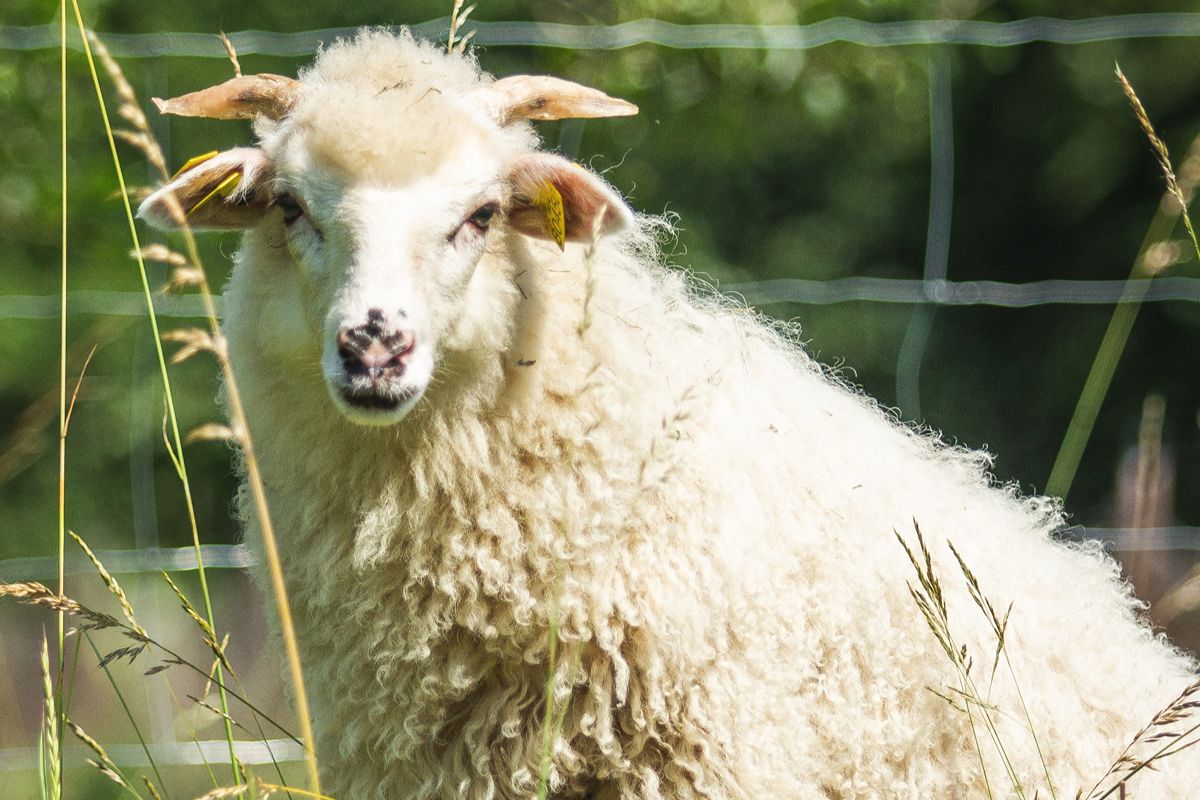
I have hand-picked 96 female sheep names with meanings also included.
List of 96 Female Sheep Names:
Blackie
Blackie comes from the Old English word ‘blæc’ and means black. In the animated short The Legend of Coyote Rock, there is a character names Blackie, which is a small black sheep. There is also the character Blackie the Lamb that was created by Paramount Pictures’ Famous Studios.
Rebecca
Rebecca has its origins in the Hebrew language and is meaning “captivating beauty” or ”to bind.” Variations I find interesting are Ríobhca in Irish and Lepeka in Hawaiian.
Woolwind
”Wolf friend.”
Bathsheba
Meaning “daughter of the oath,” Bathsheba is of Hebrew origin. According to the Bible Bathsheba had five children with King David and one is Solomon.
Galaxy
Galaxy comes from the Greek term for the Milky Way.
Meryl Sheep
Meryl Sheep is a spoof of the actress Meryl Streep. On Sesame Street, there is a muppet one.

Lovie
Lovie is a diminutive of the word love.
Feta
Feta means ”to slice” and is from the Italian fetta, most likely from cutting the cheese. Traditional feta is made from their milk. It has been protected in the EU since 2002.
Manchego
Manchego is meaning “from La Mancha” and is pronounced as man-CHAY-goh.
Halloumi
Halloumi is a cheese originating from Cyprus. The annual halloumi market is close to half a $ billion.
Caviar
The word “caviar,” is derived from the Persian word, “khavyar,” meaning cake of strength.
Liberty
“Freedom” and “free choice.”
Rambunctious
Rambunctious is symbolizing someone who is full of energy and difficult to control.
Irene
Irene is from the Greek word for “peace.” Irene of Athens was Byzantine empress consort to Emperor Leo IV.

Frosty
It means covered in frost or icy.
Luna
Luna is the Latin moon and the Roman goddess who is the divine embodiment of the Moon.
Coco
Coco means coconut in Spanish and Portuguese. The Coco is also the equivalent of the bogeyman, found in Spain and Portugal.
Sherpa
Sherpa has its origins in the Tibetan words Shar (east) and Pa (people). So, it means ”people from the east.”
Clarabelle
From the Latin and French elements clara (bright) and belle (beautiful).
Ewelina
”Living one.”
Aurora
Aurora is symbolizing ”dawn,” the Roman goddess of first light. Galileo first used the term aurora borealis in 1619.
Woolhelmina
Woolhelmina is composed of the word wool and helmina, a diminutive of Wilhelmina (resolute protector).

Poppy
Poppy is related to the flower poppy which is part of the subfamily Papaveroideae.
Buttercup
Buttercup has English origins and is symbolizing “yellow wildflower.” Princess Buttercup is the true hero of The Princess Bride.
Olive
Olive is from the Latin oliva and Livvy is a short form.
Nutmeg
“Musky nut.”
Fluffy
Fluffy is derived from the English word fluff (airy).
Dottie
It is a diminutive form of the name Dorothy, meaning God’s gift. Other diminutives of the name Dorothy are Dotty, Dot, Doro, Dorie, and Dodie.
Cotton
Cotton has roots in the Arabic qutn.
Bluebell
It is the woodland flower that is found in British forests each spring.
Tilly
“Mighty in battle.”
Lavender
From the Medieval Latin lavandula, that is possibly linked to lavare and means “to wash.”
Sassafras
Sassafras trees are a symbol of healing.
Juniper
Juniper comes from the Latin juniperus. Possible diminutives are Juno and Junie.
Primrose
”First rose.”
Bramble
“Blackberry shrub.”
Petunia
”Tobacco.” Petunia is from the French word pétun. There is a character Petunia in The Angry Birds Movie.
Cressida
Cressida is interpreted as gold or golden. There is a character named Cressida in William Shakespeare’s Troilus and Cressida. There is a moon of Uranus called Cressida.
Cinderella
Cinderella signifies “Girl By The Cinders.” Cinderella is Disney’s 2nd “princess.” In 2018, the animated film Cinderella and the Secret Prince was released.
Magnolia
Magnolia is derived from the French botanist Pierre Magnol.
Rosette
Rosette is the French diminutive of rose.
Selene
”Moon”. In Greek legends Selene is the goddess who personifies the moon and crosses the night in a silver chariot.
Freya
Freya is ”lady” in Old Norse and the goddess of love and gold. It has a common root with the German Frau.
Shanna
Shanna is a short version of the Hebrew Shoshana which means lily.
Winifred
Winifred has Old English origins and has a meaning that I love, ”blessed” or ”friend of peace.”
Marigold
”Mary’s gold.” Lady Edith’s daughter is known as Marigold Gregson in Downton Abbey.
Clover
Clover brings good fortune in three or four leaves.
Noreen
”Honor.”
Lilou
It is a diminutive of Lily, that comes from the flower lily. French-American author Lilou Macé published her first book, I Lost My Job and I Liked It, in 2009.
Zinnia
It is the flower zinnia, after the German scientist Johann Gottfried Zinn. In 2016 a zinnia became the first flower to bloom in the space station’s Veggie garden.
Seraphina
Seraphina is the feminine form of the Latin Seraphinus which comes from the Hebrew word seraphim (fiery ones).
Rachel
In Hebrew Rachel means “female sheep” and it belongs to the wife of Jacob. Rae and Rach are diminutives that I like.
Pecorino
Pecorino is Italy’s family of sheep-milk cheeses and is composed of pecora and is from the Latin pecus for livestock. Roman soldiers marched on a daily 27-gram ration of it. It is pronounced as peck-uh-REE-noh.
Beatrix
In 1943 Beatrix Potter was elected the first woman president of the Herdwick Sheep Breeders Association. It means ”voyager” or ”blessed.”
Agnes
It is from the Greek hagne that means ”pure” and combines with the Latin agnus (”lamb”). Saint Agnes has her feast on 21 January.
Fern
Fern is symbolizing “someone who lives among ferns”.
Heather
From in the Middle English hather.
Willow
Willow comes from Old English welig and Will is a common short variation. Willow bark has salicin, the natural ancestor of aspirin.
Saffron
Saffron reached English via the Arabic za’faran that has roots in a Persian word for gold. It is pronounced as SAF-run.
Hazel
Hazel is from Old English haesel.
Cinnamon
Cinnamon comes from the Greek kinnamomon. Emperor Nero burned a year’s worth of Rome’s cinnamon at the funeral of his wife Poppaea.
Honey
It has roots straight from Old English hunig.
Pearl
Pearl is the birthstone of June.
Iris
”Rainbow.”
Clementine
Clementine comes from the Latin clemens and the feminine variation of Clement.
Marshmallow
Marshmallow is made of the old Germanic marsh (that means ”a flooded area of land”) and the Latin word for soft.
Snowdrop
Snowdrop is from the German Schneetropfen.
Misty
Misty is derived from the Old English mist. Marguerite Henry’s novel Misty of Chincoteague was inspired by a Chincoteague pony.
Myrtle
“Evergreen shrub.”
Ramona
Ramona is the Spanish feminine of Ramón, from the Germanic ragin (“advice”) and mund (“protector”).
Alba
”White” or ”dawn.”
Ricotta
Ricotta is Italian for “recooked,” from the Latin recocta. Technically, ricotta is a whey product.
Lana
Lana is Latin for “wool,” and it has a similar root to lanolin, the waxy grease this animal secrete into their fleece.
Violet
”Purple/blue flower.”
Roquefort
Roquefort is from the French village Roquefort-sur-Soulzon, and combines “rock” and “strong.” In 1925 it became the first cheese to receive France’s AOC protection.
Dolly
Dolly was initially a pet form of Dorothy, “gift of God.” I found it funny that this nickname became the English “doll.”
It is also the first mammal cloned from an adult at the Roslin Institute in Scotland.
Blossom
“To thrive.”
Wren
From the Old English wrenna, a brown songbird.
Posy
It is a short form of “poesy,” an old word for poetry. From the 15th to the 17th centuries, lovers exchanged posy rings.
Tulip
Tulip came to English from the Turkish tülbend, “turban.”
Ffion
Ffion is Welsh for “foxglove,” the purple flower of hedgerows and woodland edges. It is pronounced as FEE-on.
Thistle
Thistle is from the Old English thistel.
Ruby
From ruber, “red.”
Daisy
In 1961 an IBM 7094 at Bell Labs sang “Daisy Bell.” It was the first song performed with computer speech synthesis. It is meaning “day’s eye”.
Shirley
Shirley is from Old English scir (that means “bright”) and leah (“clearing” or “meadow”). It was used mostly for boys until Charlotte Brontë’s 1849 novel Shirley.
Una
Una comes from the Irish Úna. Its meaning is uncertain, but its linked to uan, Irish for “lamb.”
Una travels leading a milk-white lamb in Edmund Spenser’s The Faerie Queene.
Meringue
Meringue is French and possibly connected to the town of Meiringen.
Gwendolyn
“Blessed ring.” Gwen and Wendy are good diminutives.
Baabara
Baabara is a variation of Barbara and comes from the Greek barbaros, “foreign.” Short forms include Babs and Bobbie.
Cumulus
Cumulus is the Latin for “heap” or “pile.”
Bo Peep
Bo Peep comes from peekaboo.
Nimbus
Romans used nimbus for a dark cloud.
Merino
In 2004 a New Zealand merino called Shrek was found after six years. His 27 kg fleece was enough to make 20 large men’s suits.
Ewenice
Ewenice has origins in the Greek Eunike, and is made from eu (“good”) and nike (“victory”).
Lamb Chop
Lamb Chop combines the Old English lamb and chop, from the Middle English choppen, “to cut.”
Mary
Mary comes from the Latin Maria that is from the Hebrew Miryam. “Bitter” and “beloved” are the main meanings. In 1830 Sarah Josepha Hale published “Mary Had a Little Lamb”.
Related articles

Funny Pirate Name Generator (Ship, Crew, Kids, Adults)

Viking Names Generator (Male, Female, Town, Village, Clan)

75 Cute & Funny Capybara Names With Meaning

Spiritual Names For Girl & Boys With Meanings

Dark Fantasy Character Name Generator (Female & Male)
