

The German language is spoken by a majority of citizens in Germany, Liechtenstein, Luxembourg, Switzerland, and Austria. So, I have selected unique German girl names, and their meanings are included.
List Of 290 Unique & Cute German Girl Names:
Freya
Freya comes from the Old Norse word for noble woman. It is popular in Germany and Scandinavian countries. In Norse mythology, Freyja is a goddess linked with magic, fertility, beauty, and love.
Yvonne
Yvonne is the feminine form of Yvon and means ”Yew tree.” Yvonne Catterfeld released her debut single “Bum” in 2001.
Thekla
Thekla has Greek origins and means “fame of God.” Thekla has been used in Germany for hundreds of years, especially in noble families. Architect Thekla Schild is the 2nd woman in Germany to receive a degree in architecture.
Ursula
Ursula von der Leyen has been the President of the European Commission since 2019. Meaning ”bear,” Ursula is from a diminutive of the Latin ”ursa.”
Monika
Monika finds its roots in the Greek language and is symbolizing “unique” as all girls are. It is a variation of Monica.
Sibylle
Sibylle is the German variation of Sybil (“prophetess”).
Hedwig
Hedwig comes from Haduwig that is meaning ”battle” or ”combat.” Hedwig of Babenberg was the mother of King Henry the Fowler. Hadewi, Hathuwic, Hatuwig, Hathewiga, Hatuuih, and Hedewiga are different variations of Hedwig.
Gisela
Gisela of Bavaria was the first queen of Hungary. It comes from gīsal (“pledge” or “hostage”).
Uta
It has roots in the Old High German od that is symbolizing “wealth” or “prosperity.” The statue of Uta von Ballenstedt in Naumburg Cathedral is one of Germany’s best-known sculptures.
Bathilda
“Bright battle.”
Brigitte
Brigitte is a variant of Bridget that is from the Gaelic noun brígh (vigor).
Heidi
Heidi is a form of the English Adelaide, “of noble birth.” Heidi became popular after the Swiss author Johanna Spyri released the children’s book, Heidi. About 50 million books have been sold.
Eva
Life.
German Baby Girl Names With Dark Meanings:
| Name | Meaning | Pronunciation |
|---|---|---|
| Herzeloyde | ”heart’s sorrow” | HAIRTS-eh-loy-deh |
| Drude | night hag | DROO-deh |
| Wolfhild | wolf of battle | VOLF-hilt |
| Alraune | mandrake | al-ROW-neh |
| Veleda | the seer | veh-LEH-dah |
| Grimhild | masked battle | GRIM-hilt |
| Sigune | root disputed | zee-GOO-neh |
| Isentrud | ”iron strength.” | EE-zen-troot |
| Mara | nightmare spirit | MAH-rah |
| Hildrun | battle secret | HILD-roon |
| Lenore | origin unclear | leh-NOH-reh |
| Ganna | sorcery | GAH-nah |
| Gerburg | spear fortress | GAIR-boork |
| Albruna | ”elf secret” | al-BROO-nah |
| Ortrun | blade secret | ORT-roon |
The list continues.
Friederike
Friederike is ”peaceful ruler.”
Erna
”Serious.”
Benedikta
Benedikta is ”blessed.”
Elsa
“Pledged to God.”
Brunhilde
It is composed of the elements ”brun” (armor) and ”hild” (battle). Composer Brunhilde Sonntag worked as co-editor of the Journal of Music Education.
Melanie
”Dark.”
Susanne
Lily.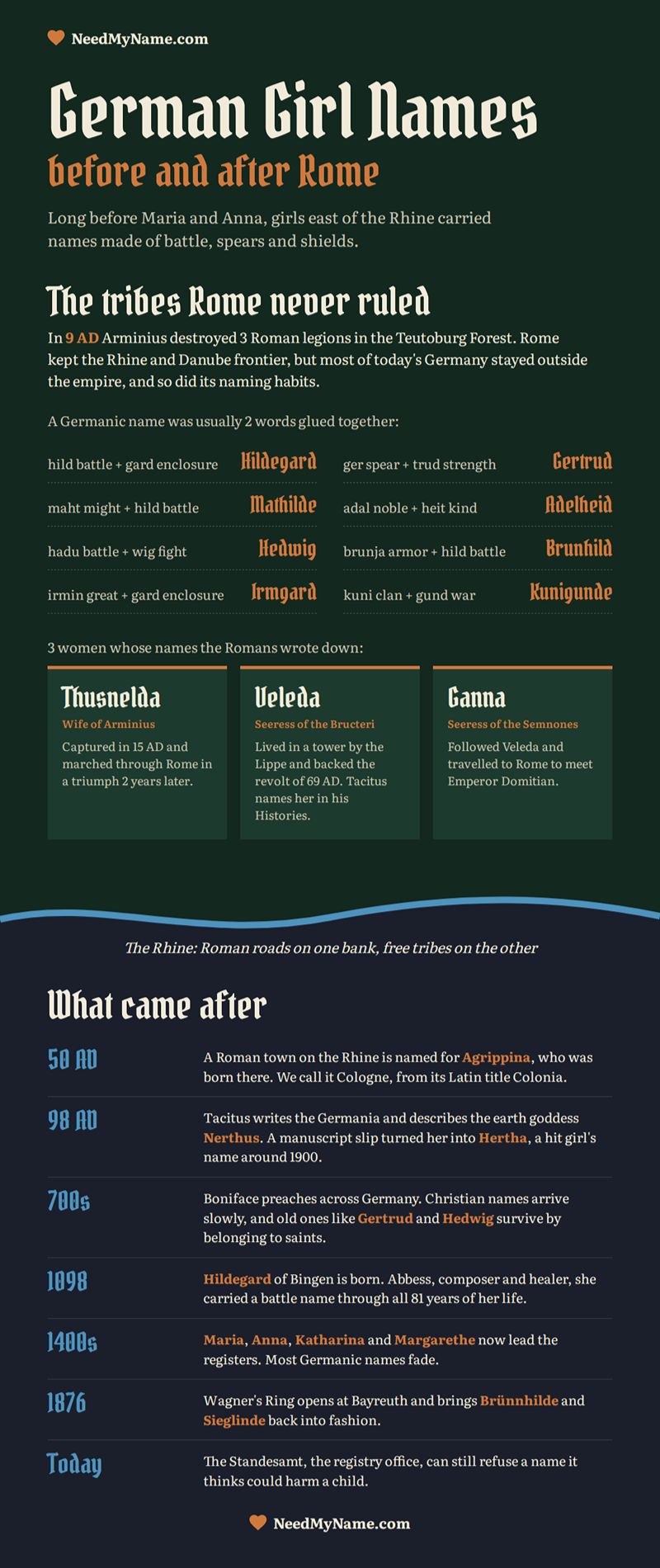
Martha
”Lady.”
Gabriele
”God is my strength.”
Irene
Peace.
Kamilla
Kamilla is a variant of Camilla, “helper to the priest.”
Linda
Linda is ”soft” and gentle.
Uncommon Germanic Baby Names:
| Name | Meaning | Pronunciation |
|---|---|---|
| Fastrada | firm counsel | fahs-TRAH-dah |
| Lioba | ”beloved” | lee-OH-bah |
| Okka | root disputed | OK-kah |
| Gerswind | strong with the spear | GAIR-svint |
| Hadmut | battle courage | HAHT-moot |
| Burgundofara | origin unclear | boor-goon-doh-FAH-rah |
| Sunhild | sun in battle | ZOON-hilt |
| Ebba | boar | EB-bah |
| Liebgard | love’s enclosure | LEEP-gart |
| Bilhildis | ”sword battle.” | bil-HIL-dis |
| Engeltrud | strength of the Angles | ENG-el-troot |
| Gotlind | gentle before God | GOT-lint |
| Diethild | people’s battle | DEET-hilt |
| Liutberga | people’s shelter | LYOOT-bair-gah |
| Erkentrud | genuine strength | AIR-ken-troot |
Scroll for more.
Waltraud
”Ruling strength.”
Adelgunde
”Noble battle.”
Ortrud
Ort (“point,” as of a sword) with trud (“strength”).
Mechthild
Mechthild is made of the elements maht (”might”) and hild (battle). Mechthild of Magdeburg was a 13th-century mystic.
Maja
“Drop of the sea”. Waldemar Bonsels made her a bee in his 1912 children’s book.
Ella
”All.”
Sarah
”Princess.”
Nina
”Little girl.”
Lea
”Weary.”
Sigrun
Sigrun is ”victory secret,” a Valkyrie of the Eddic poems.
Lara
”Protector of the house”.
Insa
“Guardian”.
English-German names for girls:
| Name | Meaning | Pronunciation |
|---|---|---|
| Stella | star | STEL-uh, SHTEL-ah |
| Jessica | coined by Shakespeare | JES-ih-kuh, YES-ee-kah |
| Alice | ”noble kind” | AL-is, ah-LEES |
| Ava | root disputed | AY-vuh, AH-vah |
| Sabrina | the River Severn | suh-BREE-nuh, zah-BREE-nah |
| Luna | moon | LOO-nuh, LOO-nah |
| Rebecca | to bind | rih-BEK-uh, reh-BEK-ah |
| Emily | ”rival.” | EM-ih-lee, EH-mih-lee |
| Fiona | fair | fee-OH-nuh, fee-OH-nah |
| Miriam | origin unclear | MIR-ee-um, MEE-ree-ahm |
| Olivia | olive tree | oh-LIV-ee-uh, oh-LEE-vee-ah |
| Nicole | victory of the people | nih-KOHL, nee-KOL |
| Diana | divine | dy-AN-uh, dee-AH-nah |
| Melissa | ”honey bee” | meh-LIS-uh, meh-LIS-ah |
| Alina | noble | uh-LEE-nuh, ah-LEE-nah |
Even more below.
Veronika
”True image.”
Walburga
”Ruler of the fortress.”
Hermine
Hermine is the feminine of Hermann, ”army man.”
Hertha
Hertha comes from a misreading of Nerthus, the earth goddess in Tacitus.
Imme
Bee.
Gudrun
Gudrun combines gunnr (battle) and rún (secret).
Theresa
The first Oktoberfest celebrated the wedding of Princess Therese (“harvester”).
Herlinde
Army with soft.
Lulu
Lulu is the femme fatale of Frank Wedekind’s plays.
Henriette
”Ruler of the home.”
Antonia
“Praiseworthy.”
Pia
”Pious.”
Gertrud
“Spear of strength.” Gertrude of Nivelles is the unofficial patron of cats.
Almut
Adal (noble) with muot (spirit).
Sunna
Sunna is the sun goddess from the Merseburg Charms.
Notburga
Notburga (“need and protection”) is the patron of servants.
Rosa
”Rose.” Rosa Luxemburg cofounded the Spartacus League.
Ortlinde
Ortlinde (“spearhead”) is one of the eight Valkyrie sisters of Brünnhilde.
Leonie
Lioness.
Käthe
Käthe is from Katharina that itself is a form of Katherine.
Dietlinde
“Soft person.”
Roswitha
‘Famous strength’ and is made of the elements *hrod* (fame) and *swith* (strong).
Philomena
”Friend of strength.”
Maren
Maren is ”of the sea.”
Ehrengard
Honor with enclosure.
Gudula
Gudula (“divine strength”) is the patron saint of Brussels.
Serafina
”Fiery.”
Hildegund
Hildegund (“warrior maiden”) is the bride who escapes from Attila’s court.
Josefine
”He will add.”
Esther
Star.
Juliane
Juliane comes from the Roman Julius.
Luzia
Light.
Sigrid
”Beautiful victory.”
Tabea
From the Aramaic word for “gazelle.” In Acts 9, Peter raises Tabitha from the dead in Joppa.

Lieselotte
Lieselotte is composed of Lise and Lotte. Lise is a diminutive of Elisabeth which is a variation of the Hebrew Elisheva (“My God is an oath”). Lotte is a diminutive of Charlotte the female form of Charles (“free man”). Chemist Lieselotte Feikes was awarded the Order of Merit of the Federal Republic of Germany.
Iris
Rainbow.
Daniela
”God is my judge.”
Wiborada
Wiborada (”female advisor”) was an anchoress killed by Magyar raiders.
Kira
”Mistress.”
Nike
Nike is victory, and Germans pronounced it NEE-keh.
Vanessa
Vanessa was invented by Jonathan Swift.
Jasmin
Jasmine flower.
Talea
“Of noble nature.”
Svea
Svea is Mother Svea, the female figure of Sweden.
Juna
”Joyful one”.
Gretel
Gretel is a variant of Greta, a name that I love and with origins in the Greek ”margarites.”
READ MORE: Beautiful Biblical Girl Names
Ingeborg
“Stronghold,” Ingeborg is from Old Norse Ingiborg. Ingeborg is popular in Norway, Sweden, Denmark, and Germany.
Alma
Alma is from Latin almus (“nourishing, kind”).
Selma
“Divine protection”.
Nena
“Baby girl”.
Sidonie
Woman from Sidon.
Helmwige
Helmwige is ”helmet battle,” a Valkyrie of Wagner’s Ring.
Afra
Afra (“from Africa”) is the patron saint of Augsburg.
Viktoria
Victory.
Mira
”Wonderful.”
Gerhild
Spear with battle.
Claudia
From claudus, lame.
Clarissa
”Bright.”
Valentina
”Strong.”
Martina
”of Mars.”
Ruth
”Friend.”
Klara
Klara is from the Latin clarus, “clear” or “bright.” Clara Schumann was one of the leading pianists of the 19th century.
Griseldis
”Dark battle.”
Vera
”Faith.”
Natalie
”Born on Christmas.”
Regina
”Queen.”
Hemma
Hemma (”homeland”) of Gurk is a patron of Austria.
Sabine
Sabine is connected with the Sabines. It was popular in Germany through the 1960s and 70s.
Rautendelein
An elf in Gerhart Hauptmann’s play The Sunken Bell.
Felicitas
Good luck.
Silvia
”Of the forest.” Queen Silvia of Sweden was born in Heidelberg.
Konstanze
”Steadfast,” and Mozart’s wife.
Fenja
Fenja (“bringer of peace”) is one of the two giantesses forced to grind gold at the mill Grotti.
Frauke
Frisian, ”little lady.”
Brangäne
Brangäne is Isolde’s maid, who swaps the death potion for a love potion.
Philippine
Philippine (“lover of horses”) Welser married an archduke in secret.
Wellgunde
Wellgunde (”well battle”) is the 2nd Rhinemaiden.
Rahel
Rahel has roots in Rachel, “ewe”.
Merle
Blackbird.
Gunhild
“Warrior woman.”
Theophanu
Theophanu (”manifestation of God”) was a Byzantine princess who married Emperor Otto II in Rome.
Perchta
”Shining one”.
Ulrike
”Prosperity and power.” At 74, Goethe proposed to the 19-year-old Ulrike von Levetzow.
Emma
”Whole.”
Heidrun
Heidrun (“secret lore of character”) is a goat on the roof of Valhalla whose udders give mead for the warriors.
Rosamunde
”Horse and protection,” and Schubert wrote music for the play Rosamunde.
Richenza
Richenza (“mighty”) of Northeim was the empress at the side of Lothair III.
Barbara
”Foreign woman.”
Cäcilie
Cäcilie (”blind”) is the patron saint of music.
Doris
Woman of Dorians.
Malwine
Malwine comes from Malvina, part of the Ossian poems.
Alwine
”Elf friend.”
Wiltrud
”Strength of will.”
Zenzi
Zenzi is the Bavarian pet form of Kreszenz, ”growing.”
Jorinde
”Flower.”
Christiane
”Follower of Christ.”
Wiebke
Frisian, ”fighter.”
Flosshilde
Flosshilde (“water-sprite of battle”) is the third Rhinemaiden.
Effi
”Pleasant speech.”
Zita
Zita (”luck”) was the last empress of Austria.
Amalie
From amal, work.
Ottilie
Ottilie is rooted in the masculine Otto which means ”wealth.” Ottilie of Katzenelnbogen was the daughter of Philipp II ”the Younger” of Katzenelnbogen.
Hildegard
”Battle and enclosure.”
Herrad
Herrad (“counselor of the army”) of Landsberg made a picture encyclopedia for her nuns.
Edda
”Great-grandmother.”
Valerie
Valerie is ”to be healthy.”
Erda
Earth goddess who warns Wotan in Wagner’s Ring.
Fricka
Wife of Wotan in Wagner’s Ring, the goddess of marriage.
Genoveva
Genoveva (“family member”) of Brabant hid in the forest for 6 years with her son.
Saskia
Saskia (“from the land of the Saxons”) was married to Rembrandt, painted by him again and again.
Andrea
From andreios, manly.
Hannelore
Hannelore is symbolizing “God is gracious.” Hannelore is made of Hanne (short form of Johanna) and Lore (diminutive of Eleanor).
Helene
Torch.
Fredegund
Fredegund (”peace”) was a Merovingian queen and a rival of Brunhilda.
Amalasuntha
Amalasuntha (”strong in work”) was an Ostrogoth queen who ruled Italy.
Ostara
”East” or ”dawn.”
Stefanie
Stefanie is ”crown.”
Hiltrud
Battle & strength.
Adele
”Noble.”
Rapunzel
Rapunzel is the rampion lettuce her mother craved.
Luise
”Famous warrior.”
Kundry
Kundry (“messenger”) is a cursed wild woman in Wagner’s opera, Parsifal.
Thusnelda
Thusnelda (“fight with a giant”) was captured by the Romans and paraded through Rome.
Gerlinde
Gerlinde is made of ger (spear) and lind (soft).
Theodelinde
Theodelinde (”protector of the people”) was a Lombard queen.
Radegund
Radegund (“counsel in battle”) was a Frankish queen who founded an abbey at Poitiers.
Senta
Senta (”to grow”) is a girl who throws into the sea to save the Flying Dutchman.
Laura
”Laurel.”
Lili
Lili is a diminutive of Elisabeth (“pledged to God”).
Heilwig
Heil (healthy) and wig (battle).
Mignon
Mignon (”love”) sings ”Kennst du das Land” in Goethe’s Wilhelm Meister.
Irma
From irmin, whole.
Grimgerde
Grimgerde is ”masked protector,” a Valkyrie of Wagner’s Ring.
Romy
From Rosemarie, and Romy Schneider played the empress in the Sissi films.
Undine
Undine (“little wave”) is a water spirit who gains a human soul by marrying a mortal.
Schwertleite
”Sword leader,” and one more Valkyrie of Die Walküre.
Plektrudis
Wife of Pepin of Herstal, who tried to hold power after his death.
Clementine
”Merciful.”
Edelweiss
White Alpine flower, ”noble white.”
Franziska
”Frenchwoman” or free.”
Isebill
Isebill (“God is my oath”) is the fisherman’s wife in the Grimm tale who wants to become God.
Thea
”Goddess.”
Bertrade
“Famous adviser.”
Marlies
Marlies comes from the name Mary which has its origins in the Greek María (beloved).
Angelika
Angelika is rooted in ángelos, “messenger.” Para-cyclist Angelika Dreock-Käser represented Germany at the 2020 Summer Paralympics.
Svenja
Svenja is the feminine of Sven, from sveinn (“boy, young man”).
Katrin
“Pure.” Katrin is a shortened version of Katherine.
Agathe
Agathe is a variation of Agatha that has origins in the Greek adjective agathós (“good”).
Dorothea
Dorothea is from Greek doron (“gift”) and theos (“god”) and is meaning “gift of God.” Nicknames that I like are Dora and Dörte.
Helga
“Holy” or “blessed” and has origins in Helgi. It is pronounced as HEL-gah.
Dagmar
Dagmar is made of dagr (”day”) and mær (”maid”). The dagr in it is a cousin of the English word day. From 1881 to 1894 Queen Dagmar of Denmark was Empress of Russia.
Gerda
Gerda is from the Old Norse garðr (“enclosure” or “stronghold”). In the myths Gerðr is a giantess courted by the god Freyr.
Hannah
”Grace.” It is also spelled Chana or Hanah.
Johanna
Johanna is a form of Joanna which is rooted in the Hebrew Yôḥānāh (”God is gracious”).
Karla
”Free man,” Karla comes from the word ”karl.”
Ida
Ida comes from the element id (“work” or “labor”).
Edelgard
”Noble enclosure.”
Bertha
It comes from ”berhta,” which means “bright one.” Bertha of Kent was the queen of Kent.
Emilia
Emilia is the feminine form of Emilio, “strive to equal.”
Edith
Edith comes from the Old English Eadgyth, ead (“wealth, fortune”) and gyð (“war”).
Gunda
“Female warrior.” In the late 19th century Gunda was popular in the Scandinavian countries.
Astrid
Astrid (“divinely beautiful”) combines the Old Norse áss (”god”) and fríðr (beautiful).
Lotte
Lotte is a diminutive of Lieselotte. I have explained the meaning of Lieselotte above.
Ingrid
It is the older form Ingiríðr and is made of Ing and fríðr (“beautiful” or “beloved”).
Sieglinde
“Victorious linden tree.”
Irmgard
Irmin (“whole, great”) and gard (“enclosure”).
Kunigunde
It is made of kuni (”clan” or ”family”) and gund (war). Saint Cunigunde was canonized in 1200.
Wilhelmine
In 1740 Wilhelmine of Bayreuth composed the opera Argenore. It is the feminine variant of Wilhelm (“protection”). Minna and Mina are short forms that I like.
Cornelia
Cornelia is rooted in cornu “horn.” Some shorten it to Conny.
Petra
Petra is the Greek word for rock and the female variant of Peter. Petra Kelly cofounded the German Green Party in 1980.
Renate
Renate comes from the Latin renatus and is meaning “reborn.” In the 70s sprinter Renate Stecher won Olympic gold for East Germany.
Verena
The root is the Latin verus (“true”).
Anneliese
Anneliese is made of Anne (“grace”) and Liese (“pledged to God”).
Elfriede
Elfriede (“elf-strength”) is made of the elements ælf (elf) and thryð (strength). In 2004 Austrian writer Elfriede Jelinek won the Nobel Prize in Literature.
Frieda
Frieda has origins in fridu “peace.”
Jutta
Jutta of Sponheim taught Hildegard of Bingen to read and chant. It is linked to Judith and meams “praised one.”
Magdalena
Magdalena means “of Magdala,” a village on the Sea of Galilee. Magda and Lena are two diminutives that I find interesting.
Lina
Lina is a diminutive of Karolina and Paulina.
Rotraut
”Famous strength.”
Luitgard
”Protection of the people.”
Reinhild
”Counsel in battle.”
Ehrentraud
”Strength of honor.”
Edeltraud
”Noble strength.”
Isolde
Wagner’s Tristan und Isolde (“ice ruler”) opened in Munich in 1865.
Oda
Oda is ”wealth.”
Beatrix
”She who brings joy.”
Erika
Erika is the feminine variant of Erik, “eternal ruler”.
Beate
”Blessed.”
Hulda
”Gracious.”
Cosima
”Order.” Cosima Wagner managed the Bayreuth Festival after her husband died.
Kriemhild
Kriemhild (“masked battle”) is a character in Nibelungenlied who avenges the murder of Siegfried.
Sophie
Wisdom.
Woglinde
Woglinde (“wave” or “billow”) is one of the three Rhinemaidens who guard the gold in Wagner’s Ring.
Melusine
”Freshwater mermaid.”
Agnes
”Pure.” Agnes Bernauer was drowned in the Danube on the orders of her husband’s father.
Rossweisse
”White horse,” another Valkyrie of Die Walküre.
Leopoldine
Leopoldine (“bold for the people”) was an Austrian archduchess who became the first empress of Brazil.
Paula
”Small.”
Ricarda
Ricarda is the feminine variation of Richard, “powerful leader.”
Ronja
Invented by Swedish author Astrid Lindgren.
Sinthgunt
Sister of Sunna in the Merseburg Charms.
Rosalinde
”Soft horse.”
Momo
Momo is a girl who wins stolen time from the gray men in Michael Ende’s novel.
Lorelei
Lorelei (“alluring enchantress”) is the rock on the Rhine.
Auguste
”Venerable.”
Marlene
Marlene is a combination of Maria and Magdalena.
Swanhild
Swan with battle.
Related articles

219 Elegant Old Money Girl Names From 1800s

263 Beautiful & Unique Ethereal Girl Names With Meanings

301 Unique & Beautiful Turkish Girl Names With Meanings

Good Female Necromancer Names & Meanings

300 Unique and Cute Korean Girl Names & Meaning
