

In Japan, cats are now so common that you see them everywhere. So, I have hand-picked 100 cute Japanese cat names with meanings included.
List Of 100 Japanese Cat Names With Meanings:
Miku
Miku is a gender-neutral name of Japanese origin and is meaning beautiful sky.
Hana
”Bloom” or ”flower.” It is also present in Hebrew where it means grace as well as to ”shine” in Maori.
Nami
”Wave.” Imado Jinja is a Shinto shrine in the Imado area of Asakusa, and there is a cat named Nami-chan that is reportedly bringing happiness to visitors.
Mochi
”Rice cake.”
Fuji
Fuji means, depending on the used kenji, wisteria, wealth, immortal, or prosperity. Fuji is also related to Mount Fuji which is the tallest peak in Japan. Around 250,000 to 300,000 people climb Mt. Fuji every year.
Suki
Loved one or beloved.
Tengu
Tengu are long-nosed mountain goblins, part bird, part monk.
Hiro
Hiro signifies generous or tolerant. In Spanish Hiro means sacred name, and it is a variant of Hairo or Chairo. Hira is the feminine version, and from Sanskrit is translated as diamond.
Kiku
”To listen” as well as ”chrysanthemum” which is a term from Ancient Greek chrysos (”gold”) and anthemon (meaning flower).
Kumo
”Spider” or ”cloud.”
Kirin
Kirin is the hoofed chimera of East Asian myth which is said to appear before the birth of a wise ruler.
Yuki
Yuki signifies good fortune or snow. Yuki is more common for females. Yuki Ebihara represented Japan at the 2007 Summer Universiade.
Shiro
Shiro generally means white, son, or castle. A variation, Shironeko, is meaning “white cat”.
Nori
Ceremony or belief.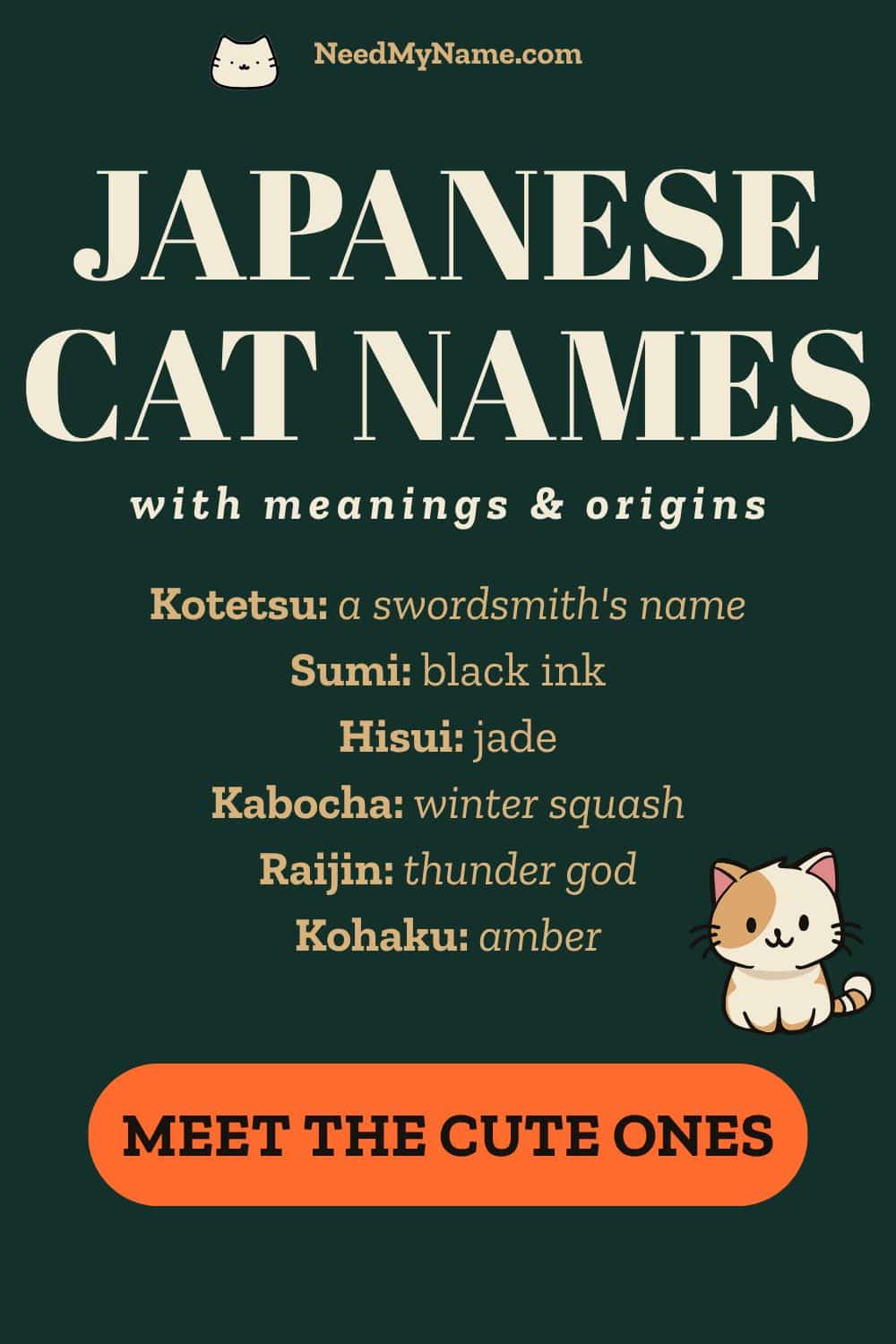
Tamamo
Tamamo-no-Mae was a court beauty unmasked as a 9-tailed fox.
Facts
There are over 9 million pet cats in Japan.
It is home to several “cat islands,” such as Tashirojima and Aoshima. On these islands the cat populations are larger than the human populations.
The demon cat bakeneko transforms into whatever it wishes. The origins of this legend go back to the 17th century.
The nekomata is a cat that has lived long enough to grow a second tail. Nekomata’s extra tail gives it supernatural powers.
Gotokuji is believed to be the original home of the ubiquitous Maneki Neko.
Tama
Tama is symbolizing ”precious stone” or ”jewel.” Tama also has Hebrew origins where it symbolizes perfection or integrity.

Chibi
Short person or little.
Matsu
”Pine.” It is a short form of the name Matsuko (“pine tree child”).
Hoshi
Hoshi has a meaning that I love, ”star.” According to online reports, a Scottish Fold cat named Hoshi became a samurai in ancient Japan.
Tobi
”Soar.” It is another Japanese name with Hebrew roots as well as a diminutive of the names Tobias and Tobiah. In Hebrew Tobi is meaning ”Yahweh is good” or ”God is good.”
READ MORE: 47 Hello Kitty Characters Names
Kiri
Kiri is a gender-neutral name that means ”mist.” Kiri also has origins in Māori (meaning skin) as well as in Khmer.
Koa
Brave one or warrior.

Sora
”Sky.” Voice actress Sora Amamiya made her voice acting debut in 2012.
Sakura
”Cherry blossom.”
Riku
Depending on the used kanji, Riku means affectionate or clever.
Neko
”Cat”.
Kaze
”Wind.” The pronunciation of Kaze is kah-zeh.
Zen
Zen comes from the Chinese character “Chan.” Chán is from the Sanskrit Dhyāna which means meditation. Zen has its origin in Buddhism itself. Zen has always made it a practice-oriented tradition. As such, Zen people have a “bigger picture” way of thinking.
How to choose a good name for your cat
Choosing a name for your new domestic feline friend is part of the fun! It’s all about choosing a name that feels natural for your cat.
Try calling a potential name out and see if your cat responds.
Try a name from another language.
Aki
Clear, sparkle, bright, or autumn. Aki is also a diminutive form of Joakim (God will raise).
Yori
It means peace or harmony.
Matcha
Matcha is green tea milled to a fine powder.
Oni
An oni is a horned ogre from folk tales.
Sota
Sota is interpreted as sudden sound or sound of the wind.
Yume
“Dream.”
Hime
Hime is the word for princess.

Momo
Peach child.
Izumi
Source of water or spring.
Musashi
Musashi (“warrior storehouse”) is the province that covered Tokyo and part of Kanagawa.
Kuro
”Black.”
Kohaku
“Amber.”
Kabocha
Kabocha is the squat winter squash with orange flesh, and I recommended it as a match for a ginger tom.
Rini
”Little bunny.” Rini also has Sanskrit origins, where it means beloved.
Midori
Green.
Fuku
Fuku means blessing or good fortune, depending on the kanji.
Umi
Ocean or sea.
Koi
Koi fish are freshwater fish that originate from Eastern Asia. There are over 20 different kinds of koi fish, and are usually kept as ornamental fish in outdoor ponds. Koi means love.
Goma
Sesame and is pronounced GO-mah.
Mikan
”Mandarin.” Ginger cats wear it well.
Anko
Sweet red bean paste, the filling inside half the desserts in Japan.
Kirara
”Sparkle.”
Daifuku
Daifuku (“great fortune”) is the pillowy mochi wrapped around bean paste.
Kinako
Kinako has the flavor of roasted soybean flour.
Purin
Purin is the wobbly caramel custard sold in every convenience store. I’ve met three cats with this name and every one of them was cream-colored.
Tsuki
”Moon.”
Hikari
”Light” and is written 光.
Sumo
Sumo is the heavyweight wrestling of the dohyo, the clay ring.
Hotaru
”Firefly.”
Subaru
“To gather” or “unite.”
Natsu
Natsu is summer, plain and warm.
Tsuru
”Red-crowned crane.” Sadako Sasaki folded paper cranes in a Hiroshima hospital before her death.
Monaka
Monaka are crisp rice wafers sandwiching bean jam. It comes from a Heian poem about the mid-autumn moon.
Ryu
”Dragon” and is the only mythical creature in the 12-animal zodiac.
Kaede
”Maple tree.” Pronounce it as kah-EH-deh.
Momiji
“Red autumn leaves.”
Botan
Botan is the ”peony” and in old tattoo work ”to courage.” A good pick for a confident cat.
Sumire
”Violet flower.”
Yuzu
Yuzu is the yellow citrus the Japanese drop whole into hot baths on the winter solstice.
Tora
”Tiger.” If your kitten has stripes, it is already waiting.
Mike
Mike is the tricolor calico coat.
Ringo
”Apple.” I like it as a staple pet name for a red-cheeked companion.
Suzu
”Little bell,”
Maru
”Round.” The most famous cat to wear it was a Scottish Fold who held the Guinness record for most-viewed animal on YouTube.
Ayame
Iris, the purple flag of early summer.
Ronin
A ronin was a samurai with no master. In early 1703, 47 of them avenged their lord.
Hachi
Number 8 is a lucky digit because the kanji 八 widens at its base. This is a shape that is like a proof of growing fortune.
Shinobu
”Endurance.”
Kotetsu
Nagasone Kotetsu (”tiger iron”) was a swordsmith in Edo and forgers copied many of his blades.
Nezumi
”Mouse.”
Kame
”Turtle, emblem of long life.
Genki
Energy and good health, and o-genki desu ka is how friends ask how life is going.
Nadeshiko
“Frilled pink carnation”. The women’s national football team plays as Nadeshiko and won the 2011 World Cup in Germany.
Azuki
Azuki are the red beans simmered into the sweet paste of wagashi.
Kin
Gold, the metal of 金. Kinkaku-ji, the Golden Pavilion in Kyoto burned about 70 years ago.
Tsubaki
”Camellia.” Its flowers fall whole instead of shedding petals.
Shiso
Shiso is the perilla leaf, green or purple and it has a scent somewhere between mint and basil.
Sansho
Sansho is the ash whose ground pods leave a numbness on the tongue.
Hanzo
Hattori Hanzo (”storehouse” or ”to hide”) was a guard captain who led Tokugawa Ieyasu to safety through the Iga mountains.
Take
”Bamboo” and is pronounced as TAH-keh.
Hayabusa
Hayabusa is the peregrine falcon, and has the nicknames Haya and Busa.
Shinju
Pearl, written 真珠, ”true gem.” Mikimoto Kokichi coaxed the first cultured pearl from an oyster.
Amaterasu
Amaterasu is the sun goddess who plunged the world into darkness.
Kinu
”Silk.”
Hagi
”Bush clover, one of the seven flowers of autumn.
Kiji
”Green pheasant,” and became the national bird in 1947.
Aoi
”Blue”.
Senbei
Senbei are rice crackers brushed with soy and grilled over charcoal.
Kagura
Kagura is the dance performed for the gods at Shinto shrines.
Kotori
Little bird.
Ichigo
Ichigo is strawberry, piled on the cream-layered Christmas cake.
Tanabata
“Evening of the seventh”.
Related articles

217 Funny & Unique Chinese Cat Names With Meanings

308 Cute Korean Cat Names & Meanings

Warrior Cats Name Generator (Clan, Random, Quiz)

250 Arabic Cat Names (male & female) With Meanings

107 Hello Kitty Characters Names and Pictures
