

Japanese couples do not use nicknames the way English speakers do. What gets used is smaller and odder: a suffix stuck on his real name. I have hand-picked 85 Japanese nicknames for boyfriend and the meanings are included.
List Of 82 Japanese Nicknames For Boyfriend
Anko
Sweet red bean paste and is the filling inside taiyaki and dorayaki.
Hayate
Hayate means “sudden gust of wind.” I think this is good for a boyfriend who never sits still.
Koibito-san
“Honorable lover.” Koibito means a romantic partner and with san it is slightly formal.
Tora
”The tiger.” A “tora” is also someone who drink to mcuh alcohol.
Ureshii
”Happy or glad.” Many couples use it since it describes how you feel.
Candy-kun
English “candy” plus the suffix kun that is used mostly for younger boys.
Koi-no-Hoshi
”Star of love.”
Kuma-chan
”Little bear.” Chan is a diminutive suffix that softens everything it touches.
Takaramono
“Prized possession” or “treasured.”
Saku
The verb for blooming and is also used for cherry blossoms opening. Short, soft, easy to say.
Nikoniko
”Smiling happily.” I’ll reserve it for the boyfriend whose face gives him away.
Otokomae
Handsome in a masculine way and is closer to “he has presence”.
Hikari
Light or radiance.
Kai
”Sea” or ”seashell.” Both are popular for boys.
Aibou
”Pal” or ”partner” and detectives use it, which gives it an unromantic loyalty.
Itoshii
”Beloved” or ”dear.”
Daisuki-kun
Daisuki is “I really like you” and attaching it to kun makes it a nickname.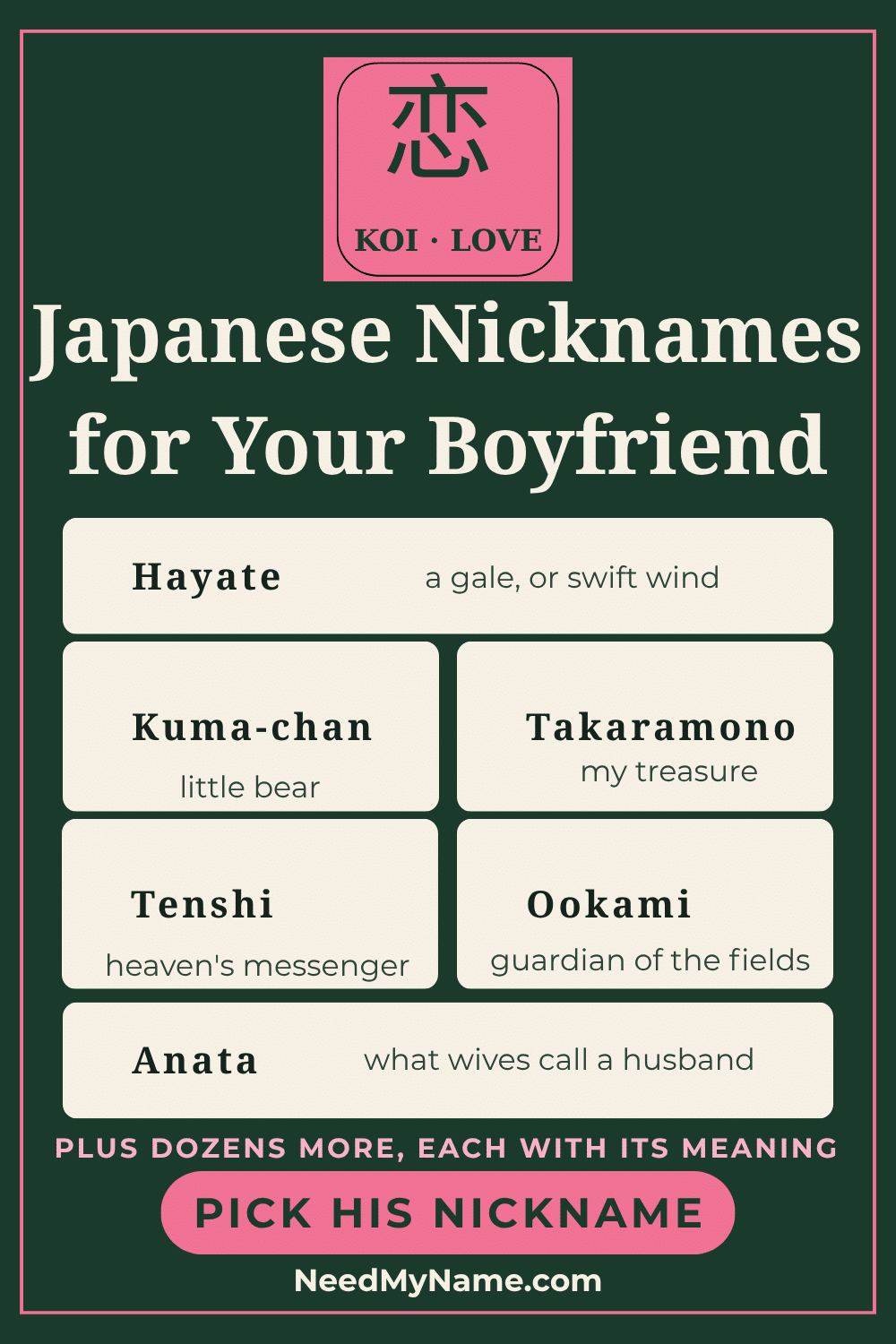
Suki-kun
“I like you.”
Natsu
”Summer.” Fits the one you met in July.
Shin
Depending on the kanji: ”new” or ”heart ”I like this one for how deep it is for a single syllable.
Tenshi
”Angel” and works straight or sarcastically. Your call.
<h3″>Tsuki
Tsuki is for a boyfriend who stay later hours since is meaning ”moon.”
Hikaru
The verb form of light, so is meaning “to shine”. Hikaru Genji is the hero of the novel The Tale of Genji.
Shizuka
”Calm” or ”peacefull”. It is suitable for a lover who says three words an hour.
Nori-chan
“Little Nori” and Nori means”order” or ”law.”
Hanii
”Honey” written in katakana as ハニー because it is from English.
Akira
Bright or clear.
Kaze
”Wind.”
Sushi-kun
For the one who orders sushi daily.
Saru
”Monkey.” Saru-mo-ki-kara-ochiru means ”even a monkey falls down a tree.”
Arata
“New field” in Japanese and ”plow” in Italian.
Kakkoii
“Good-looking” or ”cool.”
Yuki
”Snow” or ”happiness.” You can use it according to your mood.
Kaiju
”Strange beast” and is common in monster movies. There are no traditional depictions of kaijū-like creatures. Save it for the boyfriend who wrecks a room by walking through it.
Hinata
Sunny place.” Very warm and very common.
Usagi-kun
”Mr. Rabbit.” In Japanese folklore rabbits live on the Moon where they make mochi.
Haru
”To stick” or ”spring.”
Onigiri
Onigiri is a rice ball made from white rice formed into cylindrical or triangular shapes. This one I like for a boyfriend who is reliable at 7 am.
Ren
”Lotus” or ”love.” The lotus has been a top boys’ name in Japan for many years.
Risu
”Squirrel” or ”mouse” which is more accurate than flattering.
Gaki
”Brat.” In Buddhism, gaki are hungry ghosts who can never eat enough and are driven by intense emotional needs. So use it knowing the edge is here.
Sugoi
”Amazing” or ” awesome.” Say it too many times and it stops meaning anything.
Sora
”Sky”
Nobu
Faith or trust.
Wanko
”Puppy” or ”doggy” and comes from wanwan, the sound a Japanese dog makes that is similar to woof.
Baka
Idiot” or ”fool”. Between couples, it can suggest affection.
Kun
It is the suffix you attach to his actual name. For example, if yoy calling him Ken-kun instead of Ken is the single most natural move on this list.
Kira
Kira means ”glittering” or ”sparkling” and is from kirakira. Kira is also the Japanese pronunciation of the English ”killer.”
Ryu
”Dragon.” Japanese dragons are connected to water and this changes the picture a bit.
Ookami
”Wolf.”
Piyo
The chirp of a baby chick. I find it to be ridiculous on a mature man, which is actually the point.
Anime-kun
For a lover who has opinions about seasonal releases.
Kitsune
The kitsune is a fox spirit who has the ability to shapeshift. This makes sense for a clever partner who talks his way out of things.
Mochi
Mochi is a traditional rice cake that is consumed at New Year.
Ouji
”Prince.”
Chan
Chan is another suffix however is softer than kun and normally used for pets and children. Many Japanese women used it and applied to a boyfriend, it is deliberate teasing.
Takai
”Tall water” or ”high well.”
Hero-kun
English hero in katakana and a suffix.
Subaru
Subaru is the Pleiades star cluster and the car company has its inspiration for its six-star logo from the Seven Sisters.
Hoshi
Star.
Anata
“You” but wives and girlfriends have used it to address their husbands for years. It is similar to honey or dear in English.
Kawaii-kun
”Cute.” Applied to a man, it is a compliment about 80% of the time.
Chibi
”Small” or ”short.”
Melon-pan
Melonpan is a sweet bun covered in a layer of cookie dough. It is a good description of some boyfriends.
Hato
”Dove or pigeon.”
Bebi
The katakana loanword for the English “baby.”
Yasashii
Kind and tender, and the trait is what people describe in an ideal partner.
Takumi
”Artisan” or “skillful,” and is for the boyfriend who fixes things properly.
Tanuki
The raccoon dog, in folklore is reputedly mischievous and jolly. Tanuki statues are placed outside of homes as a sort of good-luck charm.
Aishiteru-kun
“The you that I love.” It’s so rare that saying it casually is almost a joke.
Rabu
Love in katakana.
Pocky
Pocky is a sweet snack food made with local Tokyo rice and water. It is produced by the Ezaki Glico company that named it after pokkin which is the snapping sound it makes.
Genki
”Energetic” or ”healthy” and is also how you ask someone how they are doing.
Momo
Peach.
Taiyo
”Sun” and is proper for one everyone else’s mood follows.
Dango
Dango are a sweet treat that is made from mochigome-ko. There is the proverb “dumplings (dango) over flowers” that means you value substance over style.
Isamu
”Courage.”
Koi
”Romantic love” or ”carp.”A pair of koi fish is a symbol for a happy marriage.
Subarashii
”Wonderful or splendid.”
Maru
”Circle.”
Jin
”Benevolence,” one of the core values of Confucian tradition.
Kame
”Turtle.” It represents longevity so the slow partner is also the one who sticks around.
Related articles

Funny Italian Nicknames For Girlfriends & Meaning

Funny Matching Nicknames For Best Friends & Meanings

Funny Pirate Name Generator (Ship, Crew, Kids, Adults)

Warrior Cats Name Generator (Clan, Random, Quiz)

Viking Names Generator (Male, Female, Town, Village, Clan)
